
Forgetting
Why phone reminders don't work
Neither you nor the app is the problem. The four-step chain every reminder has to survive is.
 Written by Lorenzo Gumiero

Contents7 sections
Phone reminders fail because they ask for four things in a row. Remembering to set them. Being available when they fire. Remembering why you set them. Acting right away. Every step has a breaking point. On busy days most of them break at once.
Why phone reminders don't work
They land on a channel you've already trained yourself to ignore, at a moment nobody picked by looking at where you are and what you're doing.
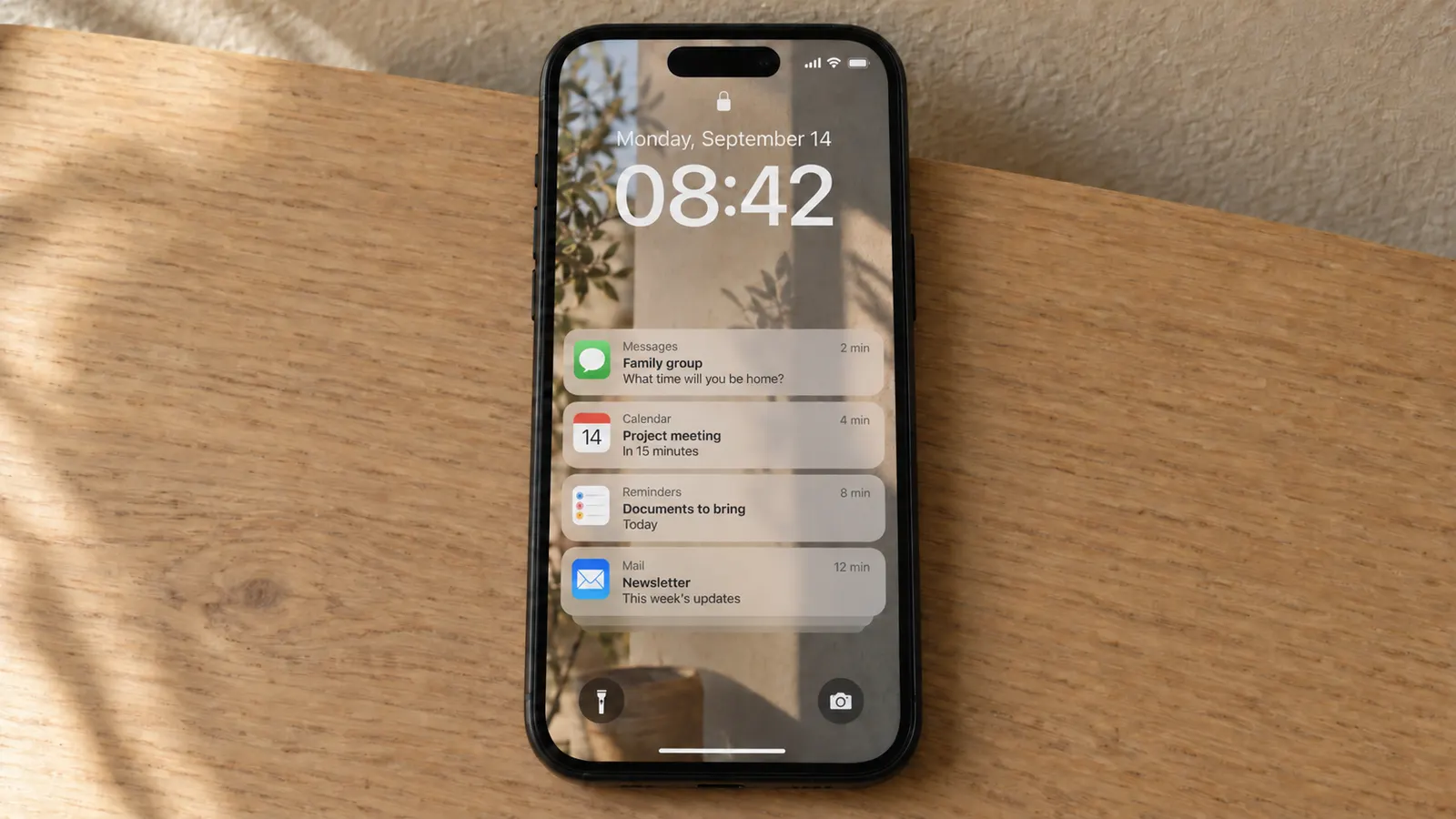
The number that gets quoted most is 63.5 notifications a day, from a 2014 study by Pielot, Church and de Oliveira presented at MobileHCI. Pielot himself has written publicly that he never trusted that figure, because the sample was fifteen people. In 2017 he ran it again across 794,525 notifications from 278 users and found a median of 56 a day. Research by Visuri and colleagues, published in the International Journal of Human-Computer Studies in 2019, found that people interact with roughly 12.3% of the notifications they receive.
In a stream like that, your reminder isn't competing with nothing. It's competing with everything else. And your brain has already filed that channel under background noise.
You have to remember to set the reminder
The first breaking point comes before the reminder does. You have to remember to create it.
The intention almost always shows up at the wrong moment: while you're driving, while you're cooking, while you're in a meeting. By the time your hands are free, the intention has passed.
People with a well-built productivity system get past this step. Most people don't. Industry figures collected by Statista and Mixpanel in 2024 put 30-day retention for productivity apps at around 4%. People download the tool, use it for a week and stop.
The reminder fires while you're doing something else
The second breaking point is timing. A fixed-time reminder doesn't know where you are.
It fires while you're on the couch, in the shower, already in the car. In almost all of those moments you can't act, so you snooze it. Snoozing is the fastest gesture in the interface. It goes automatic within days.
People who live with a lot of alarms on their phone describe the same drift. The question stops being "what do I need to do" and becomes "how do I make the noise stop." At that point the tool still works technically and has stopped working in practice.
By the time you read it, the context is gone
The third breaking point is context. A reminder that says "documents" only helps if you still remember which documents and why.
It's the same mechanism that makes you walk into a room and forget what for. The alert fires, you ignore it for ten seconds, and in those ten seconds the reason you set it has already left working memory. The label survives, without the thing it referred to.
Reminders that survive this step have long, specific labels. The ones typed in a hurry with a single word don't.
Why location-based reminders arrive late
They fix the timing problem on paper and reintroduce it in practice, because your phone's position updates with a delay.
The system can't poll GPS continuously without draining the battery, so it samples at intervals. The smallest radius the platforms let you set runs to around a hundred meters. The "when I leave home" alert reaches you once you're already on the street. We covered this in more technical detail in why leaving-home automations fire late.
For Android users there's one more piece of news. In 2025 Google removed location-based reminders during the migration from Keep to Tasks. The feature is no longer natively available.
When phone reminders actually work
In three situations they work perfectly well.
When the label is specific and written at the moment of the intention. "Bring Mom's test results to the doctor" survives. "Results" doesn't.
When the event is fixed and recurring. Clocking in, lunch, school pickup, evening medication. Here the clock really is the right cue. A recurring reminder set once holds up for years.
When the phone is the safety net rather than the main system. People who have a physical system that works, a hook, a tray, a packed bag, and use an alarm only as a final check, get the best results of anyone.
All three take setup effort up front. The people who forget most are often the same people who can't build that system. That's where the phone stops being a solution.
What changes when the reminder doesn't come from your phone
The channel changes. With the channel, the odds that the alert gets seen.
An alert that reaches you at the door isn't competing with notifications. It doesn't ask you to unlock anything. It can't be dismissed by the gesture you've already automated. It lines up with a movement you're making anyway, so it asks for no extra attention.
The moment changes too. A timed reminder is a guess about where you'll be. A reminder tied to picking up your keys isn't a guess. You're at the door by definition, and you're still inside.
That's the principle Dory is built on. If you want the category in general, we explained it in our guide to smart key trays. If you want the method without buying anything, it's in how to stop forgetting things when you leave home.
Frequently Asked Questions
Timed ones work for fixed, recurring events. Location-based ones suit errands out of the house, where a few minutes of delay changes nothing. For the moment of leaving home, they almost always arrive late.
Because the brain learns to treat a channel based on the average of what comes through it. If most notifications are irrelevant, the automatic response becomes dismissal. That response fires before you've read the content.
Not much, if the problem is the four-step chain. Better apps make creating a reminder less of a chore. No app fixes the fact that the alert lands on a saturated channel, at a moment chosen in advance.
The sturdiest figure comes from a 2017 study by Pielot, Vradi and Park across 794,525 notifications from 278 users: a median of 56 notifications a day. The widely quoted 63.5 is from 2014 and rests on fifteen people.
Yes. In 2025, during the migration of reminders from Keep to Tasks, Google removed the ability to set place-based reminders. On Android the feature is no longer natively available.
Keep reading
 ForgettingGifts for people who forget everythingThe right gift for someone who forgets everything doesn't help them remember better. It removes the need to remember. The gifts that work have one [...]Written by Lorenzo Gumiero
 ForgettingThe mental load at home: who remembers everything for everyoneMental load is the invisible work of holding the state of a household in your head: what's due tomorrow, who needs to bring what, what's running out [...]Written by Lorenzo Gumiero
 ForgettingADHD and everyday forgetfulness: change the environment, not your headWith ADHD, everyday forgetting is more often a cueing problem than a memory problem. The information is there. What's missing is the signal that [...]Written by Lorenzo Gumiero