
Forgetting
How to stop forgetting things when you leave home
Seven methods ranked by how well they work. And why almost all of them stop working after two weeks.
 Written by Lorenzo Gumiero

Contents8 sections
To stop forgetting things when you leave home, change the environment instead of training your memory. An object placed on your path beats a list you have to consult. A signal that changes beats one that never does. Everything below is free and runs on its own.
How to stop forgetting things when you leave home
The method that works best moves the work from your head into the space around you. Instead of remembering to take something, you put it where you can't avoid running into it.
Cognitive psychology calls it offloading the intention. Instead of keeping a reminder alive in working memory, you leave a signal in the environment and let the environment interrupt you. On why intentions fall away right as you leave, we wrote why we always forget our keys.
Seven ways to do it, from the strongest to the most fragile. None of them cost anything.
Put things along your path, not in one spot
Most people build a single drop zone near the door. It works, right up until that zone becomes an archive. Once it also holds last week's mail, a pharmacy receipt and a cable, it stops being a filter and becomes a pile.
The alternative is to think about the path. Shoes where you sit down. Lunch where you pass the fridge. Keys where your hand lands before you open the door. Each object at the point in the house where your hand actually meets it.
Attach what you forget to what you never forget
You always take your keys. You don't always take the gym bag. Put the bag next to the keys and it works while you're paying attention. Put the keys inside the bag and there's no way out without meeting it.
This holds for everything. Medication on top of your coffee mug. A folder resting on your shoes. A document tucked into the umbrella handle. The weak object goes on top of or inside the strong one. Never beside it.
Use the door as a block
It's the bluntest method and the most effective for things you can't afford to forget tomorrow.
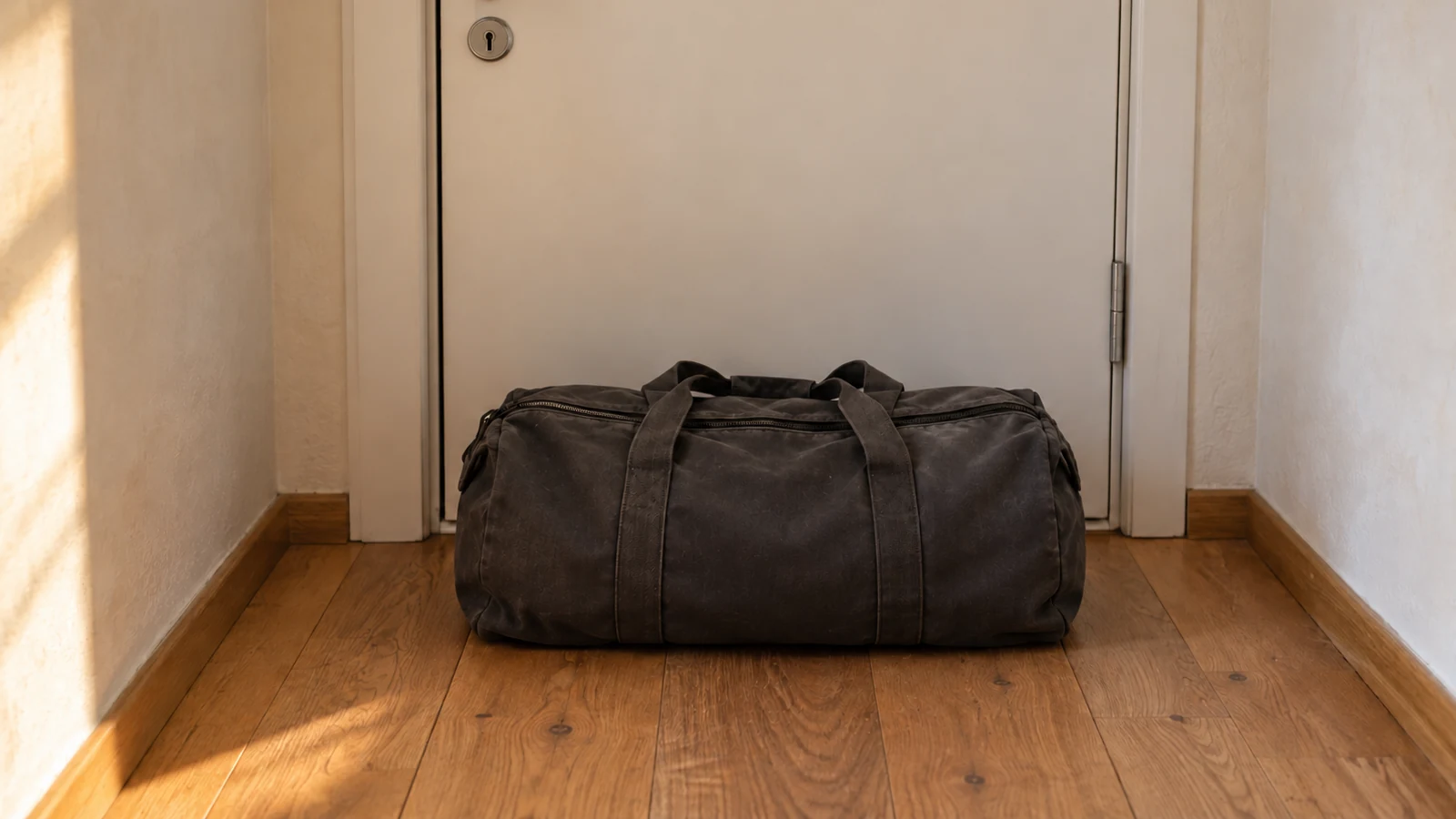
Put the object on the floor, in front of the door, the night before. Not on a table. In front, where you have to move it or step over it to get out.
It looks bad and it almost always works, because it asks you neither to remember nor to notice. It only asks you to open the door.
Prep the night before, and remember to prep
Evening prep is the most recommended thing in the world and it has a flaw almost nobody names. It becomes its own thing to remember. You've moved the forgetting from eight in the morning to eleven at night, when you're more tired.
The way to make it hold is to attach it to something you do anyway. After the dishes. While your phone charges. The moment you get home, before you sit down. Evening prep attached to an existing gesture survives. Evening prep left to willpower lasts a week.
Change the signal before it goes invisible
Any signal that's always there and always the same stops registering. The note on the door becomes wallpaper. The whiteboard becomes decor. The tray becomes part of the furniture.
In the public conversations we read, habituation is the most cited failure for physical entryway solutions. The counter-move is novelty. Shift the tray a few inches now and then. Change the color of the note. Rewrite the same sentence in different words. A signal that changes keeps working. One that doesn't, doesn't.
What to do on off-routine days
On off-routine days habits don't help, because habits don't remember, they execute. The sequence that carries you to the door with everything in hand snaps as soon as one piece changes. And those are also the days when forgetting costs most.
The last two methods are for those days. Prepping the night before just for them, even if you never otherwise do. And a physical stopping point: hand on the handle, one second, before you open it. No mental checklist involved. Just a pause attached to a gesture you make anyway, at the last instant it can still help.
When a method isn't enough
The methods above work well for fixed objects. They struggle with two things.
Anything that changes daily. A fixed spot doesn't know that today it's swim practice, tomorrow it's a birthday gift and the day after it's paperwork to hand over.
Homes with more than one person. A system built by one person is maintained by that one person. When that person steps back, it collapses. We wrote about it in the mental load at home.
Those two points need something that changes the message every day and knows who to give it to. That's the job an active device at the door does. We explained it in our guide to smart key trays. Ours is called Dory.
Frequently Asked Questions
Put the object physically on top of or inside something you always take, like your keys or your bag. Physical dependency beats any reminder, because it asks you neither to remember nor to look.
Habituation and accumulation. After a week or two your eye stops registering it. Once everything else lands there too, it stops being a filter and becomes a pile you ignore.
At night, almost always. Mornings give you less time and more hurry. The one thing to watch is attaching evening prep to a gesture you already make, or it becomes a second thing to remember.
A fixed list helps with everyday objects and misses whatever you only need today. If you make one, keep it short and hang it where you actually walk, not where you think you should.
Signals at the point of action beat general lists. The change of clothes in the open backpack, the snack on top of the shoes. A reminder placed where the gesture happens works far better than one said in the kitchen ten minutes earlier.
Keep reading
 ForgettingGifts for people who forget everythingThe right gift for someone who forgets everything doesn't help them remember better. It removes the need to remember. The gifts that work have one [...]Written by Lorenzo Gumiero
 ForgettingWhy phone reminders don't workPhone reminders fail because they ask for four things in a row. Remembering to set them. Being available when they fire. Remembering why you set them. [...]Written by Lorenzo Gumiero
 ForgettingThe mental load at home: who remembers everything for everyoneMental load is the invisible work of holding the state of a household in your head: what's due tomorrow, who needs to bring what, what's running out [...]Written by Lorenzo Gumiero