
Forgetting
Gifts for people who forget everything
Six ideas that solve a real problem. And three that look like a good idea and are a reprimand with a bow on it.
 Written by Lorenzo Gumiero

Contents8 sections
The right gift for someone who forgets everything doesn't help them remember better. It removes the need to remember. The gifts that work have one thing in common: you put them somewhere and from then on they do the work themselves, without asking anyone for discipline.
What to give someone who forgets everything
The gifts that work change the person's environment instead of asking them to change their habits.
That's the line between a useful gift and one that ends up in a drawer. A planner asks for daily commitment. A tray by the door asks for nothing. The first depends on motivation, which comes and goes. The second works during the bad weeks too. On why forgetting clusters right at the front door, we wrote why we always forget our keys.
Six ideas, ranked by how well they hold up over time.
A fixed spot for keys
An entryway tray or hook is the simplest gift on this list and the most underrated.
It works because it removes a decision. Someone with no place for their keys makes a fresh choice every evening, and every evening they can get it wrong. Someone with a fixed spot stops deciding.
Two things to get right. Size: it should hold what that person empties from their pockets, with little margin, or it turns into a collector of mail and coins. And material: a metal tray at seven in the morning wakes the house. Wood, felt and cork make no noise.
A tracker for things that go missing
A Bluetooth tracker to clip to keys or slip into a wallet does one thing and does it well. It tells you where an object went once it vanished. For someone who spends twenty minutes a week hunting for keys at home, it's a gift that gets noticed immediately.
Two things to check before buying. Compatibility with that person's phone, since some only work properly inside their own ecosystem. And the fact that a tracker covers the object it's attached to and nothing else: the lunch in the fridge and the documents on the desk stay uncovered. The comparison is in AirTag, Tile or a smart key tray.
Clear containers and labels
A set of clear containers and a label maker is an unromantic and very effective gift.
An object you can't see stops existing in your planning, even when you know exactly where it is. Closed drawers, opaque boxes and high shelves are domestic black holes.
It works better when the gift targets one specific zone: the medicine shelf, the pantry, the cable drawer. A generic set with no destination stays in its box.
A pill organizer with the days marked
For anyone taking something daily, a weekly pill organizer answers a recurring question. Did I already take it today?
The answer is visible without remembering anything. Today's compartment is either open or closed.
Give it lightly, because it touches something personal. Better alongside something else. Better without commentary about how much it was needed.
A pre-packed kit
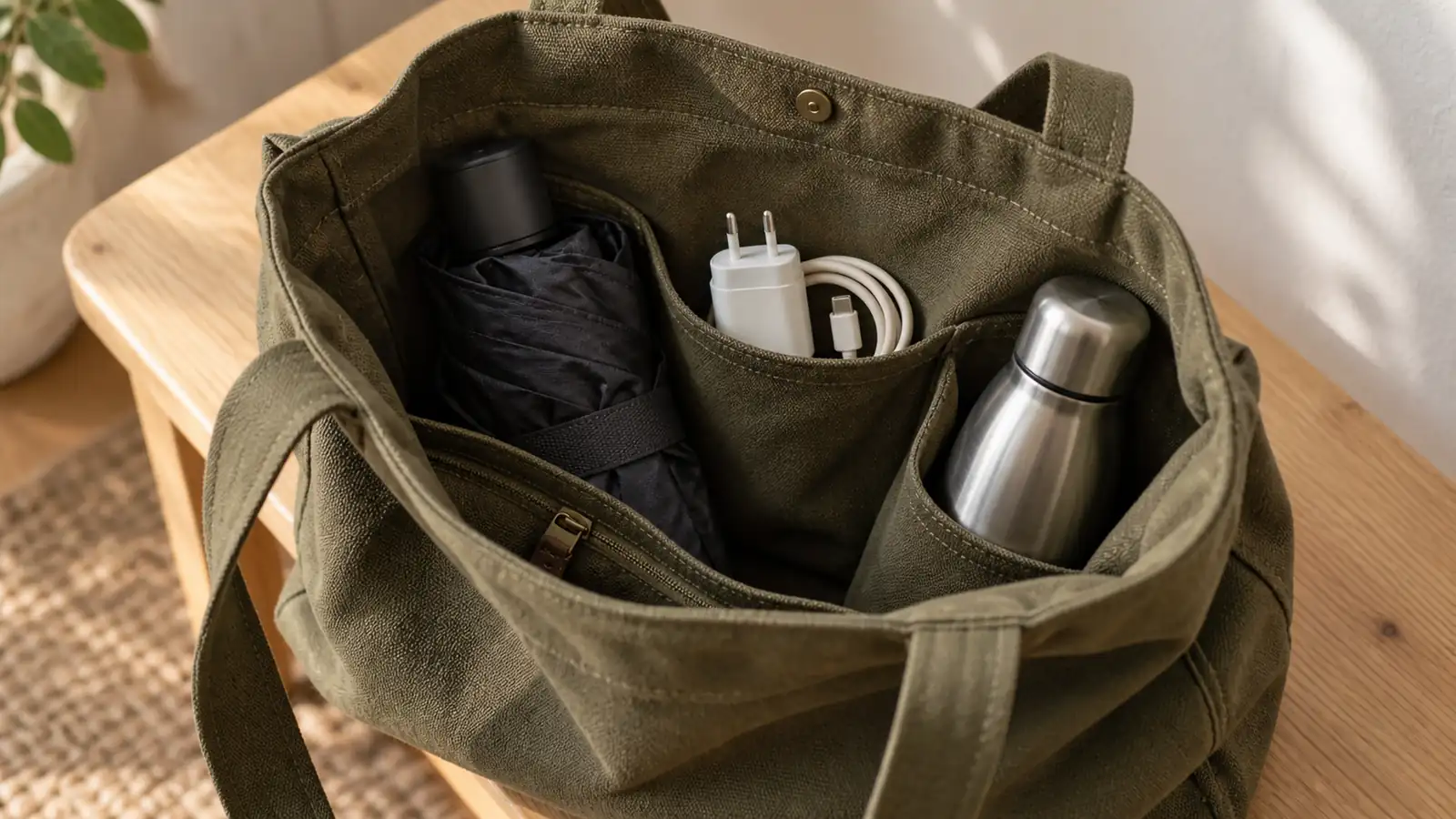
A second copy of the things that always get forgotten is one of the smartest and least obvious gifts there is.
A spare charger that lives in the bag. A folding umbrella that never leaves the backpack. A second pair of sunglasses in the car. A water bottle that stays at the office.
It works because it asks nobody to remember. It only asks that the object already exist where it's needed.
A smart key tray
A smart key tray is the right gift when the problem is walking out without something, not losing it.
It recognizes the moment the person picks up their keys and uses it to tell them something: a reminder they set, a message from someone at home, a suggestion pulled from their calendar or the forecast. It steps in while the person is still inside, when turning around costs three steps.
It's a good gift for people whose days look different from each other and for households with more than one person, because everyone hears their own things. The category is explained in the guide to smart key trays. The one we're building is called Dory.
What not to give
Three categories that look perfect and almost always land badly.
Paper planners and journals. They need daily upkeep, so they work for people who are already organized. For people who forget, they add one more task and one more thing to forget.
Books on personal organization. They read like a diagnosis. Even the excellent ones carry the message that the problem is effort. Anyone living with this difficulty has already tried everything.
Joke gifts about forgetfulness. Mugs, magnets, cards with punchlines. Between close friends they work. Outside that circle they're a reminder of something the person already lives with.
The rule is one. A gift shouldn't feel like a correction. If explaining it means saying "so maybe you'll stop," it's the wrong gift.
Frequently Asked Questions
An object that changes the environment instead of the habits. A fixed spot for keys, a tracker or a spare kit all work because they ask for no daily discipline. They keep helping through the most chaotic weeks.
A Bluetooth tracker if the problem is finding them at home, a tray or a hook if the problem is having no fixed spot. The two combine well because they cover different moments of the day.
It can, if it reads as a judgment. The safest approach is choosing an object that's good on its own, presenting it as what it is, and not explaining what it's supposed to fix. A beautiful tray stays a beautiful tray.
A quality entryway tray, ideally with a couple of wall hooks. In the first weeks in a new home there are no habits yet. That's when a fixed spot takes root most easily.
It depends on how much that person enjoys setting things up. A simple object works immediately and has no batteries. A device does more, but it has to be plugged in and configured. It only makes sense if the recipient wants to do that.
Keep reading
 ForgettingWhy phone reminders don't workPhone reminders fail because they ask for four things in a row. Remembering to set them. Being available when they fire. Remembering why you set them. [...]Written by Lorenzo Gumiero
 ForgettingThe mental load at home: who remembers everything for everyoneMental load is the invisible work of holding the state of a household in your head: what's due tomorrow, who needs to bring what, what's running out [...]Written by Lorenzo Gumiero
 ForgettingADHD and everyday forgetfulness: change the environment, not your headWith ADHD, everyday forgetting is more often a cueing problem than a memory problem. The information is there. What's missing is the signal that [...]Written by Lorenzo Gumiero