
Forgetting
ADHD and everyday forgetfulness: change the environment, not your head
Why sticky notes and alarms stop working after a week, and what to put in their place.
 Written by Lorenzo Gumiero

Contents7 sections
With ADHD, everyday forgetting is more often a cueing problem than a memory problem. The information is there. What's missing is the signal that brings it back up while you can still use it. That's why redesigning the space works better than training your memory.
Why everyday things get forgotten with ADHD
People with an ADHD diagnosis describe working memory as one of the heaviest daily limits there is. Working memory is where you hold things active for a few seconds while doing something else. It's the place intentions fall out of.
You know you need to bring the documents. You knew it this morning, you knew it last night. As you approach the door, that information isn't active anymore, because your head is already handling something else. You didn't erase it. It just didn't come back up at the right moment.
That changes the kind of solution you need. Remembering better isn't a lever you can pull. Getting the information handed back to you at the right moment is. The general mechanism, which applies without any diagnosis, is in why we always forget our keys.
What "out of sight, out of mind" actually means
An object you can't see stops existing in your planning, even though you know exactly where it is.
It's why closed drawers become black holes, why food at the back of the fridge expires, why a bag put away in a closet never gets used again. It isn't disorganization. Access to the memory of that object ran through your eyes.
The typical solutions come from here: clear containers, open shelves, labels, everything out. They're sensible and they work, up to a point.
Why keeping everything in sight isn't enough
Out of sight means forgotten. Always in sight means invisible.
A signal that stays in the same place and says the same thing stops registering within days. The note on the door becomes wallpaper. The whiteboard becomes decor. The tray in the entryway becomes part of the furniture.
Among people who tried anchoring objects at the door, this is the most cited complaint in the public conversations we collected. We searched for them ourselves, starting from our own words, so they describe the tone of the problem rather than its spread.
There's a second, nastier failure. The object is right there, you walk past it and don't see it. The system looks like it's working until the day you needed it.
A passive signal isn't enough. You need something that changes.
Why phone alarms stop working
They work as long as there are few of them and they stay attached to a reason you remember. Then they collapse, for three reasons that come up again and again in people's accounts.
Accumulation. Once alarms run into the dozens, the automatic response becomes dismissing rather than listening. The gesture happens before the reading.
Losing the reason. The alert fires, you snooze it for ten seconds, and in those ten seconds the reason you set it has already left working memory. The word survives, the thing it referred to doesn't.
The phone itself. To set a reminder you have to pick it up, and picking it up opens a door onto everything else. That gesture doesn't cost ten seconds. It often costs twenty minutes and a day that restarts from scratch.
Alarms work beautifully in some cases: long specific labels, recurring events that never change, the phone as a safety net on top of a physical system that already holds. The full picture is in why phone reminders don't work.
What works: change the environment, not your head
The principle that holds up best moves the work from memory into space. Not remembering to take something. Making it impossible to leave without running into it.
Physical dependency is the strongest move. The object you forget goes on top of or inside the one you always take. Lunch on the keys. Documents inside the bag, not next to it. Keys inside the gym bag on gym day.
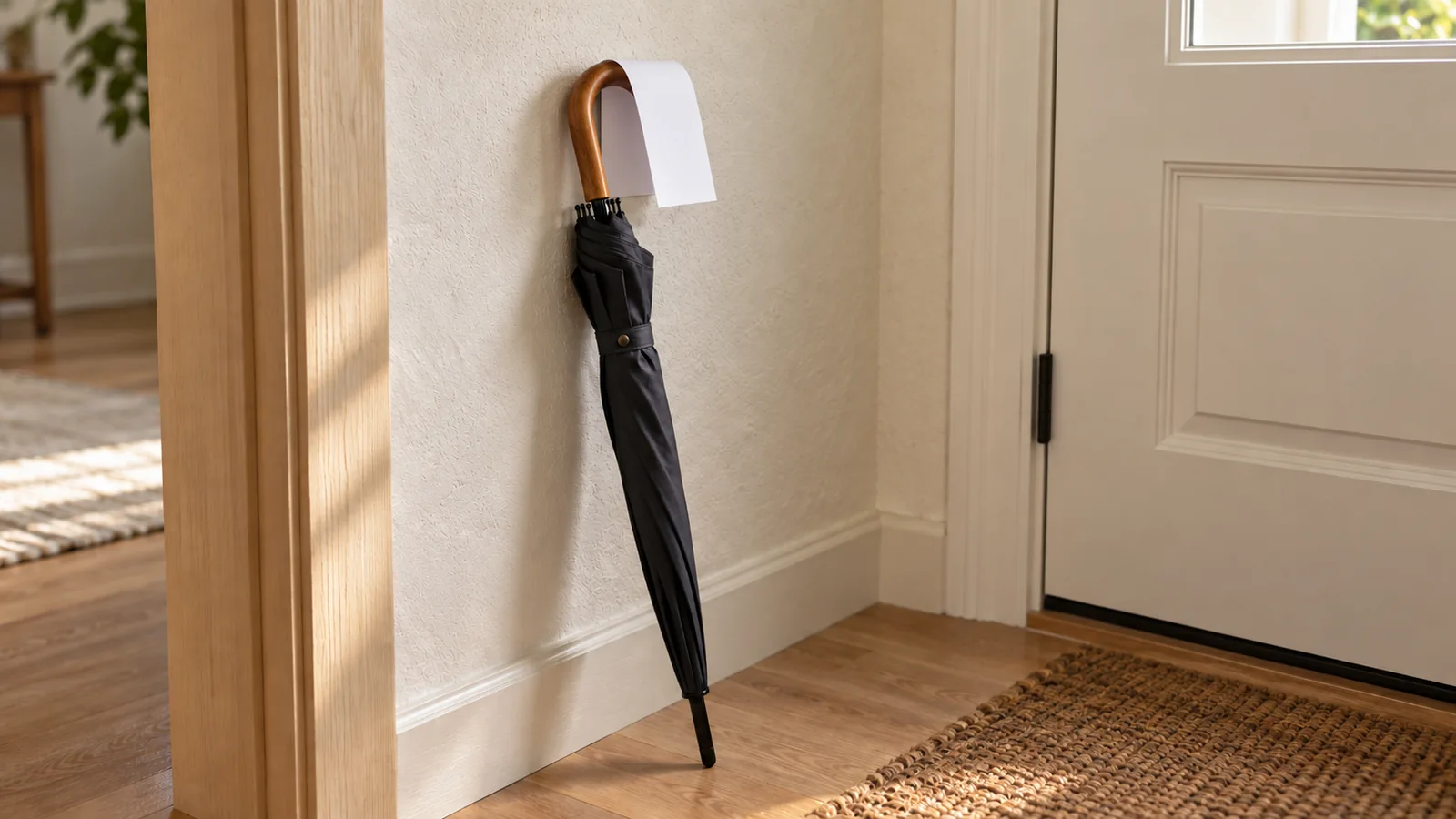
Right after that comes the physical block. Anything you can't forget tomorrow goes on the floor in front of the door tonight. Ugly to look at and close to foolproof.
Then scheduled novelty. Move the tray now and then, change the color of the note, change the wording. Novelty is the one thing habit can't switch off.
Finally, signals at the point of action. A reminder for something that happens at the fridge goes on the fridge. A general list in the kitchen, for things that happen elsewhere, gets ignored within a week.
The entryway is where concentrating effort pays off most, because it's the last moment you can still fix anything. One spot for keys, few surfaces and small ones, nothing that adds a step: a basket with no lid beats a box with a lid, every time. The rest is in how to organize your entryway.
When you need an active signal
When what you need changes daily. A fixed spot doesn't know today is documents and tomorrow is the swim bag. The load varies, the signal doesn't.
When off-routine days are your main problem. Habits don't remember, they execute. On days that break the sequence they all fail at once, and those are also the days when forgetting costs most.
An active signal interrupts, says something different each time, and arrives attached to a gesture you make anyway. That's what we're building with Dory. The category is explained in the guide to smart key trays.
What you don't need to be told
Almost all advice on this topic assumes the problem is effort. Try to be more organized, make a list, pay more attention. Anyone living with this kind of difficulty has already tried everything and knows that isn't the lever.
This isn't about becoming more productive. It's about stopping the fight with your own memory and building a route around it. A well-designed home does part of the work, and that part doesn't have to be won back every morning.
One last thing. This article is about home organization and isn't a clinical assessment. If forgetting is weighing on your daily life, a professional is the right place to talk about it.
Frequently Asked Questions
Because the information doesn't come back up at the moment of leaving. Working memory holds few things at once. In the transition to the door, attention is already at the destination. Nothing was erased. The cue simply never came.
Habituation. A signal that's always there and always identical stops registering within days. On top of that, whoever wrote it stops updating it, and a stale note becomes background noise.
Keep things visible where they're used, cut the number of steps each gesture takes, and physically attach the objects you forget to the ones you always take. Clear containers, lidless baskets, one single spot for keys.
They work when there are few of them, with specific labels, used as a safety net on top of a physical system. They stop working once there are dozens, because the automatic response becomes dismissing rather than reading.
No. Everyday forgetting is common and depends on stress, workload, sleep and life stage. Only a professional can make a diagnosis. It's worth talking to one if it's genuinely weighing on your day.
Keep reading
 ForgettingGifts for people who forget everythingThe right gift for someone who forgets everything doesn't help them remember better. It removes the need to remember. The gifts that work have one [...]Written by Lorenzo Gumiero
 ForgettingWhy phone reminders don't workPhone reminders fail because they ask for four things in a row. Remembering to set them. Being available when they fire. Remembering why you set them. [...]Written by Lorenzo Gumiero
 ForgettingThe mental load at home: who remembers everything for everyoneMental load is the invisible work of holding the state of a household in your head: what's due tomorrow, who needs to bring what, what's running out [...]Written by Lorenzo Gumiero