
Smart home
Why leaving-home automations fire late
Nearly every departure trigger measures where you are. Location always arrives after the intention. From there it's late by definition.
 Written by Federico Zarantonello
Contents7 sections
Leaving-home automations fire late because almost all of them rely on your phone's location, which gets sampled at intervals across a radius of at least a hundred meters. By the time the system works out that you've left, you're already on the street. The lights go off behind a closed door.
Why leaving-home automations fire late
None of the common triggers detect the intention to leave. They all detect a consequence of leaving, once it has happened.
Geofencing registers that a phone crossed a boundary. A door sensor registers that the door opened. A smart lock registers that the bolt moved. A presence sensor registers that nobody is in the room anymore.
For turning off lights the delay can be fine. For a reminder it never is. Neither is it for a routine that has to take effect while you're still inside.
How geofencing works and why it has latency
Geofencing draws an area around your home and fires an action when your phone enters or leaves it.
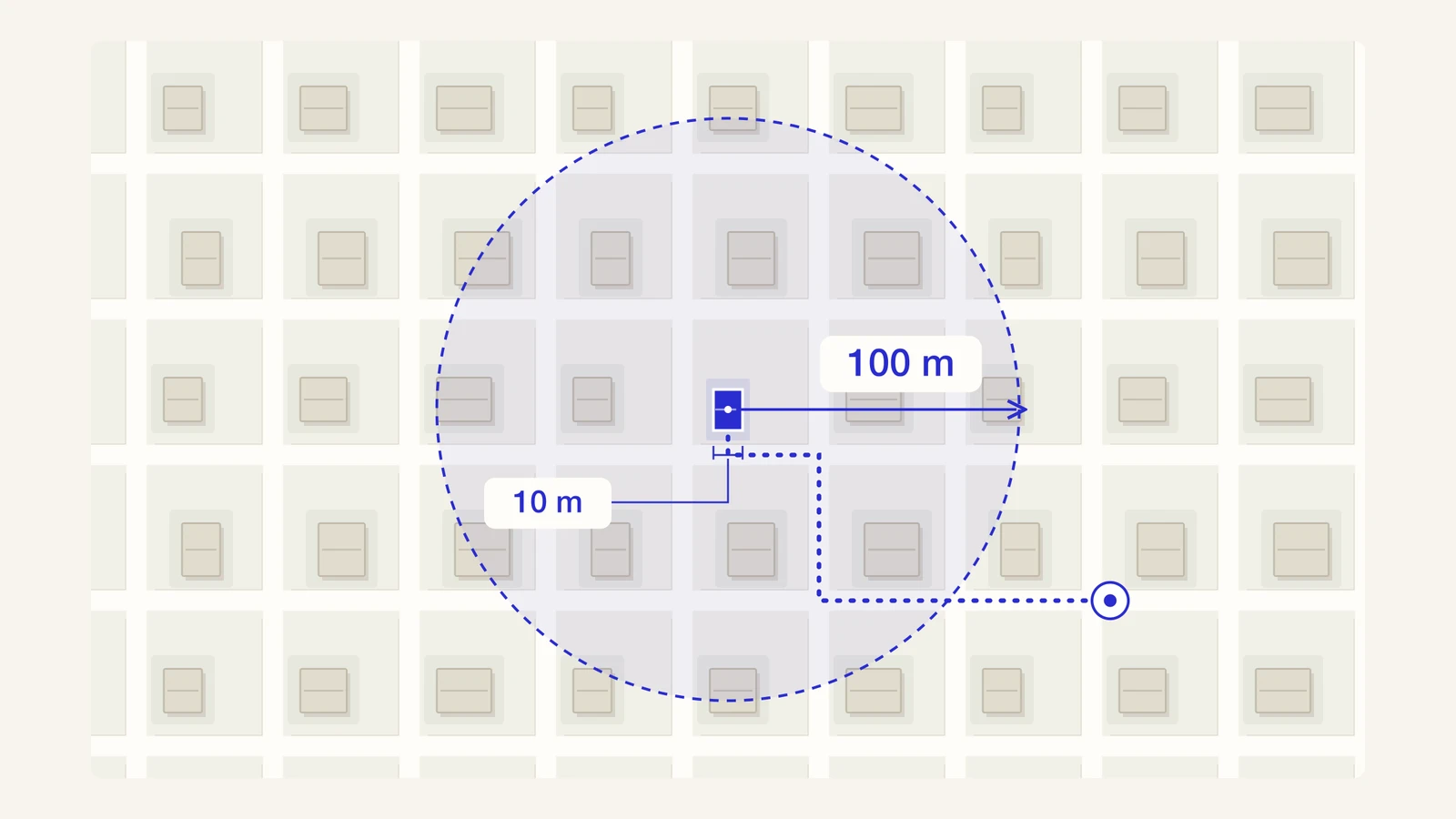
The delay comes from two constraints. The operating system doesn't poll location continuously, because the battery couldn't take it: it samples at intervals and checks the boundary only when it has new data. And platforms won't let you draw an area the size of an apartment, because below a certain size the position error would cause constant entering and exiting.
Wide boundary, intermittent checking. For leaving home that's the worst possible combination, because between the moment you pick up your keys and the moment your phone crosses a hundred-meter circle, everything you cared about has already happened.
How late is a leaving-home automation, really
Public estimates vary quite a bit. Read them per product, not in general.
| Mechanism | Delay reported by sources | Identifies who's leaving |
|---|---|---|
| GPS geofencing, general | roughly 30 seconds to 6 minutes, accuracy between 5 and 50 meters | phone only |
| Location reminders on iOS | 2-6 minutes, minimum radius 100-150 meters | phone only |
| Location reminders on Android | native feature removed in 2025 with the Keep to Tasks migration | not applicable |
| Tracker separation alerts | 5-10 minute range in real conditions, on a radius of about 100 meters | no |
| Door sensor | instant, but on the wrong event | no |
| mmWave presence sensor | 1 to 3 seconds, on presence in a zone | no |
| Gesture trigger (Dory) | milliseconds from gesture to effect | yes |
The first six rows come from public industry summaries and manufacturer documentation. They're orders of magnitude: real latency shifts with the operating system, power saving, signal quality and the geometry of the building.
The last row is ours. Dory doesn't estimate a position, so it has nothing to wait for. That's the difference between registering an event and measuring a quantity.
Why presence detection doesn't know who's leaving
Presence sensors know whether someone is in a room. They don't know who. Above all, they don't know what that person is about to do.
An mmWave sensor in an entryway detects a person standing or moving within a couple of seconds. In a narrow entryway it also produces false positives, because someone walking through to the bathroom generates the same signal as someone about to walk out.
Voice assistants have the same limit in a different shape. They can tell you the house is empty, and to get there they wait for every phone to leave the area. In a household of three, a single departure generates no useful event.
Devices with a camera really do recognize people. The price is a camera pointed at your entryway, and plenty of households don't want to pay it.
Why door sensors and smart locks are still too late
A door sensor is instant and measures the wrong thing. By the time the door opens, the intention to leave is ten or twenty seconds old and your hands are already full.
For turning off lights that delay is irrelevant. For telling you that you left your lunch in the fridge it changes everything, because turning around has gone from costing three steps to costing a decision.
Smart locks have the same problem moved a few inches. They detect at the bolt, so after the door. Excellent for access, useless for the reminder.
What changes when the trigger is a gesture instead of a location
A gesture-based trigger removes the latency and adds identity, because it doesn't have to estimate anything.
Location has to be measured, and every measurement carries an error and a sampling interval. A gesture either happened or it didn't. There's no boundary to cross and no radius to draw. That's why milliseconds pass between the gesture and the effect instead of minutes.
Picking up your keys also has three properties no location trigger has. It happens while you're still inside. It belongs to exactly one person. And it's already in your routine, so it doesn't ask you to remember to press anything. That's why smart buttons almost always fail at this particular job.
Dory recognizes two gestures, picking up your keys and putting them back, and it knows whose keys they are. From there it starts a routine on the platform you already run. We covered the physical alternatives in physical triggers for your smart home. Interoperability is in what Matter is.
What a physical trigger doesn't solve
If you don't touch the tray, nothing happens. Someone who walks out with keys that have been in their pocket since last night generates no event. That's why a safety net is needed, usually a phone notification, designed well or it becomes one more ignored notification.
There's also something a departure trigger can't know: whether you actually left. Picking up your keys and then stopping for ten minutes to answer a message happens to everyone. Automations that should only run on an empty house need confirmation. There, a door or presence sensor is still the right place to look for it. The two systems work together, not one instead of the other.
Frequently Asked Questions
Public summaries put typical latency between roughly half a minute and six minutes, with position accuracy between 5 and 50 meters. The real value depends on the operating system, battery settings and the geometry of the building.
Only up to a point. Platforms enforce a minimum radius in the hundred-meter range. Below that threshold, position error would cause constant entering and exiting.
It's more precise and still late. It fires when the door opens, which is after you've decided to leave and with your hands already full. Fine for turning off lights. Not fine for a reminder.
In 2025 Google migrated reminders from Keep to Tasks. The place-based feature was dropped in that transition. On Android there's no longer a native way to set a reminder tied to leaving home.
That depends on the device. What matters is whether it exposes an event to the platform through an open standard. Dory is compatible with Matter, Alexa, Google Home, Apple HomeKit and Home Assistant.
Keep reading
 Smart homePhysical triggers for your smart home: what they are and when they helpA physical trigger is a device that starts an automation from something happening in the real world, rather than from a phone's location or a clock. [...]Written by Federico Zarantonello
 Smart homeWhat Matter is and why it changes the smart homeMatter is a standard that lets smart devices from different brands talk to each other without a separate app for each one. A Matter-certified device [...]Written by Federico Zarantonello
 EntrywaySmart key tray: what it is and how it worksA smart key tray is an entryway tray that notices when you pick up or put down your keys and uses that moment to remind you of something. From the [...]
 Written by Thomas David Short