
Forgetting
Why we always forget our keys
Why the gesture slips exactly when it matters. And why the bowl by the door stops working after two weeks.
 Written by Lorenzo Gumiero
Contents7 sections
You forget your keys because by the time you reach the door, your head has already arrived where you're going. Your body is still at home. Your attention isn't. In those few seconds almost everything happens that later costs you four minutes, a sprint back up the stairs and a day that starts wrong.
Why you always forget your keys
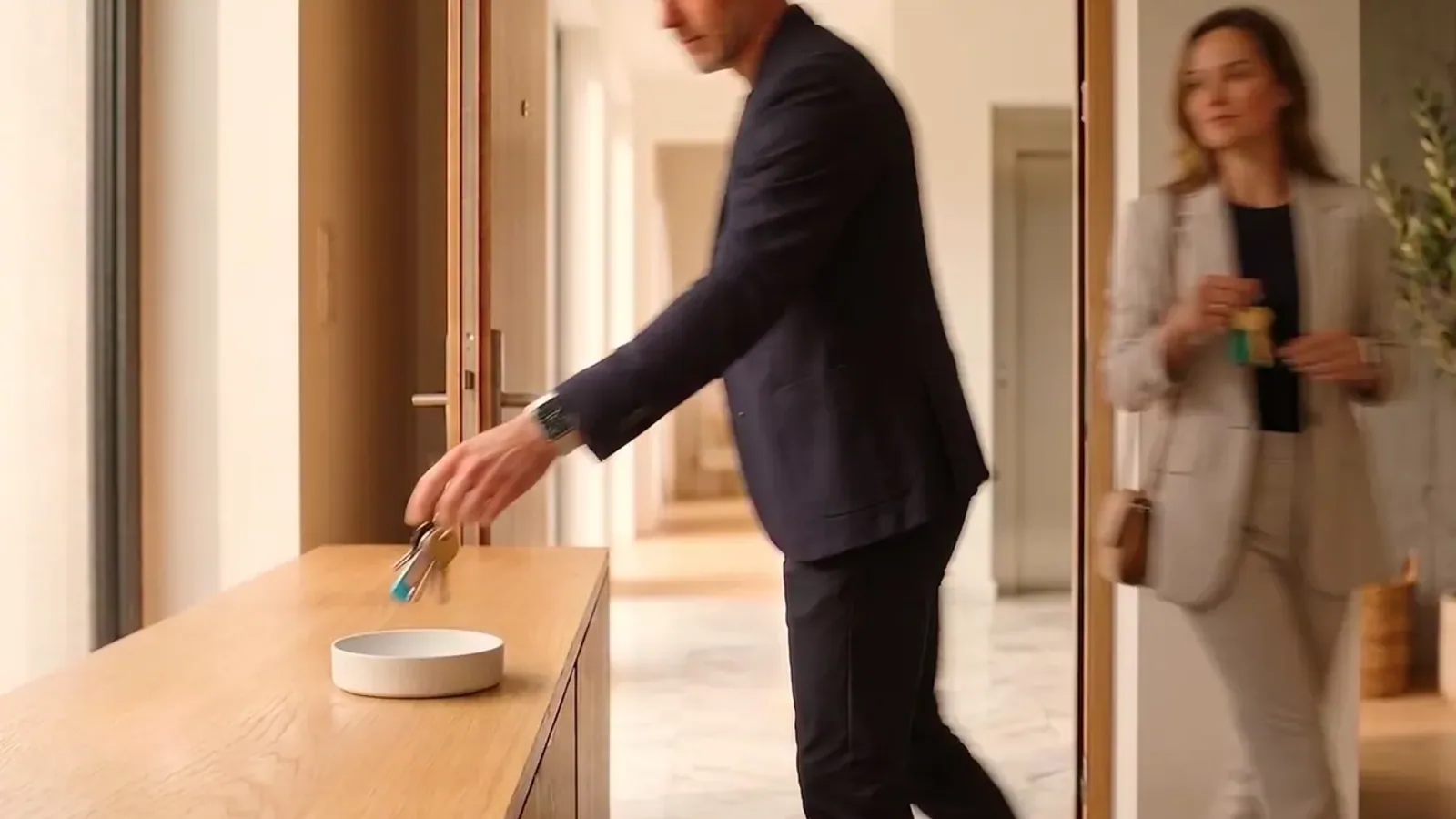
Picking up your keys is an automatic gesture. Automatic gestures leave few traces in memory.
The brain records what it pays attention to. On your way out, your attention is somewhere else: the nine o'clock meeting, the traffic, that thing you left unfinished yesterday. The gesture gets carried out without being recorded. Or it doesn't get carried out at all and nobody notices.
This isn't willpower. It's how prospective memory works, the ability to remember to do something later. That kind of memory needs an external cue. If the cue doesn't come at the right moment, the intention stays exactly where it was, correct and useless.
Losing your keys and walking out without them are two different problems
People searching "I always forget my keys" usually have one of two problems. It pays to separate them, because the fix isn't the same.
The first is not finding them. The keys are in the house and you don't know where. You set them down while you were on the phone and the gesture was never recorded anywhere. The remedy is a fixed spot, or a way to make them ring.
The second is walking out without them. The keys are exactly where they belong. You're already on the landing with the door closing behind you. What was missing is a signal at the moment of leaving.
Trackers only touch the first problem. They alert you once the keys are already far away, which means after the door has shut.
Why you always notice too late
The cost of forgetting changes all at once over a few seconds.
While you're still inside, fixing it costs three steps. You turn around, grab the thing, leave. The moment the door closes, the same lapse costs you a decision: climb back up and be late, or go on without it. If the keys are what stayed inside, there's no decision left to make.
There's a cruelty in the timing, too. You almost always notice at the exact moment you needed the thing. In the car, at the office turnstile, at the school gate. Never a minute earlier.
Why the bowl by the door stops working
The bowl by the door is the most common solution in the world. It fails in four recurring ways.
We read 304 public Reddit conversations where people describe what they forget and what they've tried. We searched for those threads ourselves, using our own keywords, so they say a lot about how the problem gets described and nothing about how widespread it is. With that said, the four modes come back with surprising consistency.
Habituation, the most cited of them all. The dedicated spot turns into scenery within a week or two. After a while your eye stops seeing it.
Broken routine, which hits mornings that run out of order. The objects never make it to the bowl. The system only holds on the days you didn't need it.
Third-party interference, meaning partners, kids and roommates who tidy up. The fixed spot stops being fixed, usually without anyone noticing.
Phantom memory, the nastiest one. The object is right where it belongs, you walk past it and don't see it. The system looks like it's working until the day you needed it.
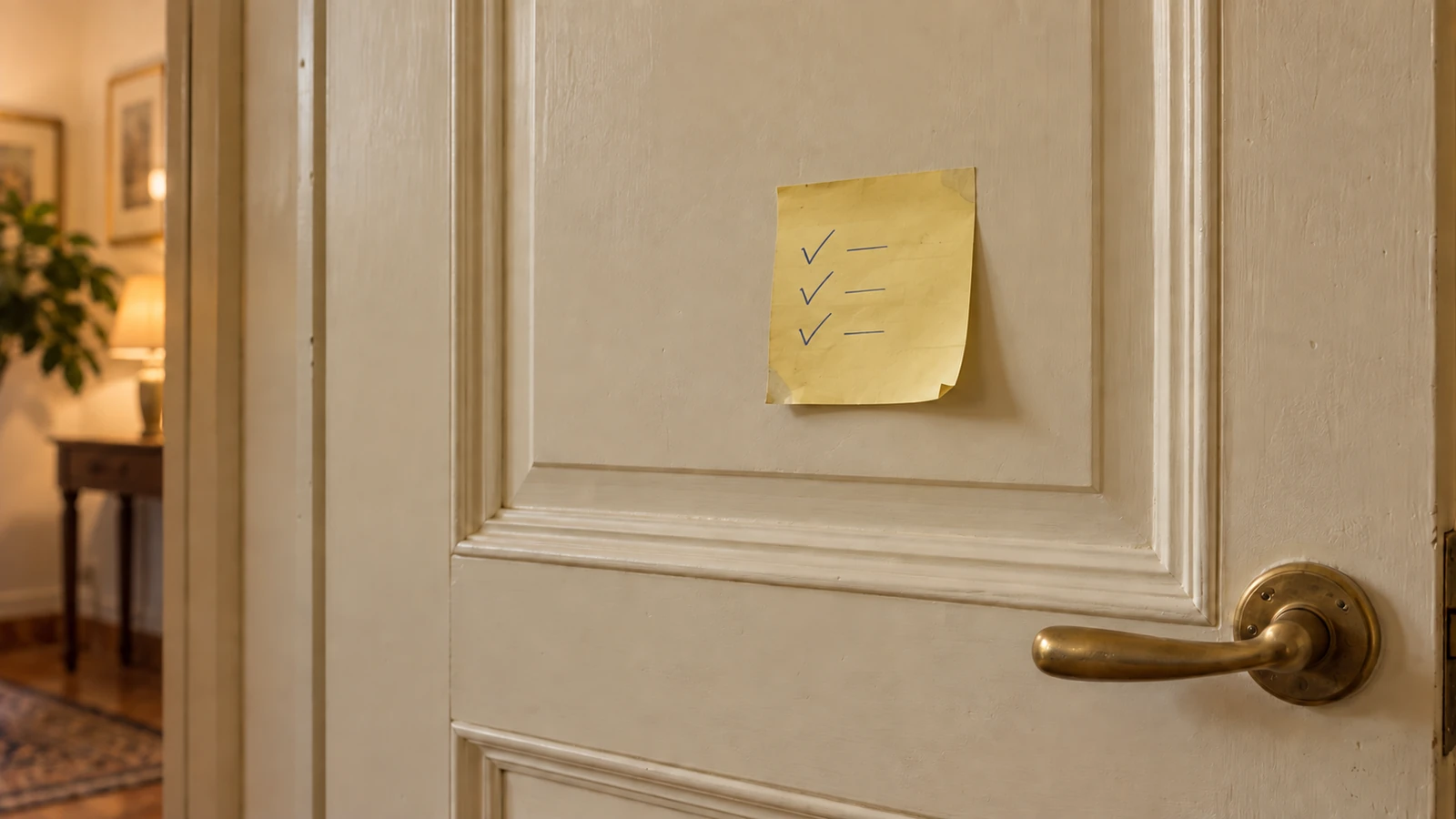
Underneath all four is a single paradox. Out of sight means forgotten. Always in sight means invisible. An object that never moves and never changes loses its grip through the same mechanism that turns the note on your door into wallpaper.
Why off-routine days are the worst
Forgetting spikes when the sequence changes. An earlier alarm, a trip, an appointment out of hours, a day that starts in a different room.
Habits don't remember. They execute. A repeated sequence carries you to the door with everything in hand without you having to think. Move one piece and the chain snaps somewhere, often at the last link.
And off-routine days are also the days when forgetting costs most. Your ID matters precisely on travel day. Your badge matters precisely on the day of the offsite.
Why a mental checklist isn't enough
A checklist works as long as you remember to run it. On hard days you don't.
"Phone, keys, wallet," said out loud with a pat on the pockets, is among the most widely used solutions there is. It holds on routine days and fails on exactly the days that break the routine, because nothing sets it off. Phone alarms fail for different reasons. We listed them in why phone reminders don't work.
There's a second limit too. The checklist is always the same. It covers the fixed objects and misses what you need today and didn't need yesterday: the swim bag, the gift, the folder you promised to drop off.
What actually works to stop forgetting your keys
Three moves, all free.
Put the fixed spot on your path, not beside it. If dropping your keys costs you two extra steps, those two steps get skipped on the day you're in a hurry.
Attach the weak object to a strong one. You always take your keys, you don't always take your lunch, so the lunch goes on top of the keys. The document goes tucked into the umbrella handle. On top or inside, never beside.
On bad days, hand on the handle, one second, before you open it. It isn't a mental checklist. It's a physical stopping point attached to a gesture you make regardless, and it's the last instant you can still turn around. The other methods, limits included, are in how to stop forgetting things when you leave home.
That second on the handle is also why we're building Dory. What an object that guards that moment does is explained in our guide to smart key trays and on the home page.
Frequently Asked Questions
Forgetting everyday objects on busy days is common and means nothing on its own. If it increases sharply, starts covering things that used to be automatic, or worries you, talking to a doctor is the sensible move.
Because hurry takes up your attention. With your head already on the next thing, picking up your keys happens without being recorded, or doesn't happen at all. Less attention available means fewer traces in memory.
Only partly. It helps you find keys once they're lost and alerts you after you've already walked away. It doesn't tell you to take them while you're still on your way out, which is when you'd actually need it.
Habituation. A signal that's always there and always the same stops registering within days. On top of that, whoever wrote it forgets to update it, and a stale note becomes noise.
People with an ADHD diagnosis describe working memory difficulties as one of the heaviest daily obstacles there is. We wrote about it in [ADHD and everyday forgetfulness](/blog/adhd-and-everyday-forgetfulness).
Keep reading
 ForgettingGifts for people who forget everythingThe right gift for someone who forgets everything doesn't help them remember better. It removes the need to remember. The gifts that work have one [...]Written by Lorenzo Gumiero
 ForgettingWhy phone reminders don't workPhone reminders fail because they ask for four things in a row. Remembering to set them. Being available when they fire. Remembering why you set them. [...]Written by Lorenzo Gumiero
 ForgettingThe mental load at home: who remembers everything for everyoneMental load is the invisible work of holding the state of a household in your head: what's due tomorrow, who needs to bring what, what's running out [...]Written by Lorenzo Gumiero