
Smart home
Physical triggers for your smart home: what they are and when they help
Buttons, tags, sensors, gestures. What each one solves, where it fails, and which to pick for the moment you leave the house.
 Written by Federico Zarantonello

Contents8 sections
A physical trigger is a device that starts an automation from something happening in the real world, rather than from a phone's location or a clock. It matters when the automation has to be immediate, reliable and tied to a specific moment in the day.
What a physical trigger is in a smart home
It's the source of an event that comes from an action or a change in the environment, not from a condition the software calculated.
Home automations start in three ways. From a time. From a condition, like a phone's location or another device's state. Or from a physical event: a door opening, a button pressed, a presence detected, an object moved.
The practical difference is uncertainty. A time is always the same and knows nothing about what you're doing. A location has to be estimated, so it carries error and delay. A physical event either happened or it didn't. The system knows the instant it does.
Why a physical trigger beats a location trigger
On two fronts: latency and identity.
Your phone samples location at intervals to save battery, and the minimum boundary radius runs to about a hundred meters. A contact opening or a gesture happening generates an event right away. We went into detail in why leaving-home automations fire late.
Location tells you which phone moved, not which person is doing what. In a household of more than one, that distinction decides whether automations are useful or shared noise.
Smart buttons: when they work and when they don't
A smart button is the simplest physical trigger and technically the most reliable. A press produces an immediate event.
It works well for actions you want to command yourself. Movie scene, everything off, start the robot vacuum. These are things you decide to do. Pressing is a comfortable way to do them.
It doesn't work for leaving the house, for the same reason a reminder doesn't. You have to remember to press it. In public Home Assistant community discussions this is a recurring complaint: the button gets installed, used for two weeks, then forgotten precisely on the days it would have mattered. A trigger that requires remembering doesn't solve a memory problem.
NFC tags: when they work and when they don't
An NFC tag is cheap, has no battery and starts an automation when you hold your phone near it.
It works beautifully where the phone is already in your hand and the action is deliberate. A tag on the nightstand for night mode, one at your desk for work mode, one in the car.
For leaving the house it has two problems. It asks for an extra gesture, so it inherits the button's flaw. And it needs an unlocked phone in hand, which is the least reliable condition of the morning.
There's an instructive precedent. In 2014 a Kickstarter project called OCHO Pad proposed an entryway pad based on NFC tags attached to every object. It barely reached its goal and never shipped. Tagging every single thing you might forget isn't work anyone does twice.
Door and window sensors
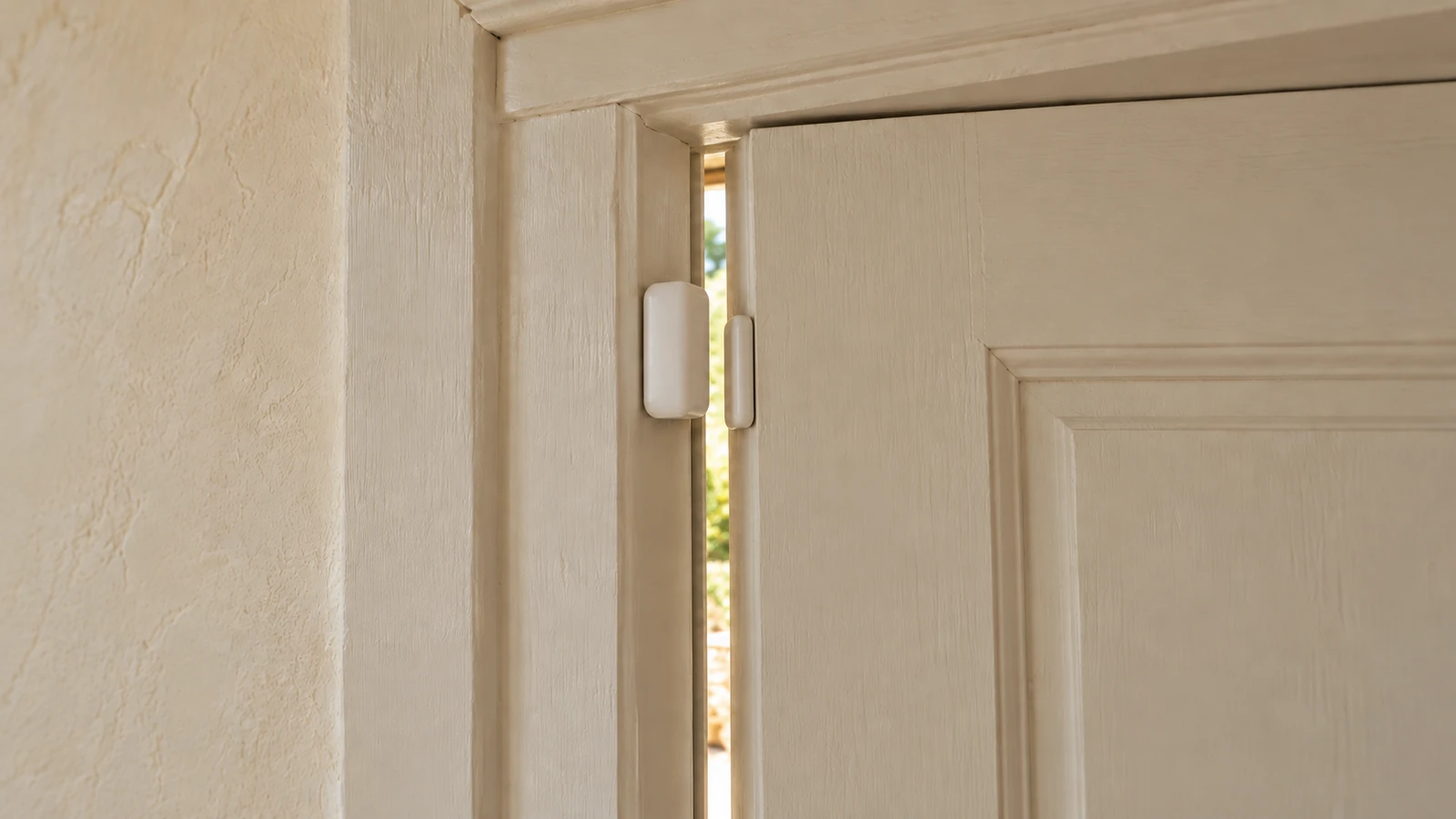
A contact sensor is the most common physical trigger, the cheapest and the most reliable. It detects opening and closing without ambiguity and without false positives.
It's perfect for security, for open-window alerts and for confirming that someone actually left. It's also the simplest way to know the house is genuinely empty.
The limit is timing. The door opens after you've decided to leave, keys already in hand and often with your hands full. For turning off lights that's fine. For telling you that you forgot something it's already late.
Presence and mmWave sensors
Millimeter-wave sensors detect people who are sitting still, not just moving. That makes them far better than older motion sensors for rooms where people sit.
In an entryway they have one clear role. They confirm whether anyone is home, within a couple of seconds.
They don't know who the detected person is, though. And in a small entryway they produce false positives, because someone walking through to the bathroom generates the same signal as someone about to leave. A presence sensor answers "is anyone there." It doesn't answer "who's leaving and what do they need."
Triggers tied to a gesture you already make
The last family is the newest and the least common. These are triggers attached to a gesture that's already part of your routine, asking nothing extra.
They don't inherit the flaw of buttons and tags, because there's nothing to remember: you make the gesture anyway. And if the device also recognizes the person, the event carries identity with it. No other trigger has that.
At the front door there's only one candidate gesture. Picking up your keys means leaving, putting them back means you're home. That's what we're building Dory on. For the category, we wrote the guide to smart key trays.
The limit to plan for is that the gesture has to actually happen. Someone whose keys have been in their pocket since last night generates no event. There, a well-designed safety net is needed.
How to pick the right trigger for leaving home
Start with the type of action. If you're the one deciding to do it, a button or a tag is fine. If it has to happen without you thinking about it, you need a sensor or a gesture you already make.
Then ask whether you need to know who. If the answer is yes, door sensors, presence sensors and group geofencing leave the stage immediately.
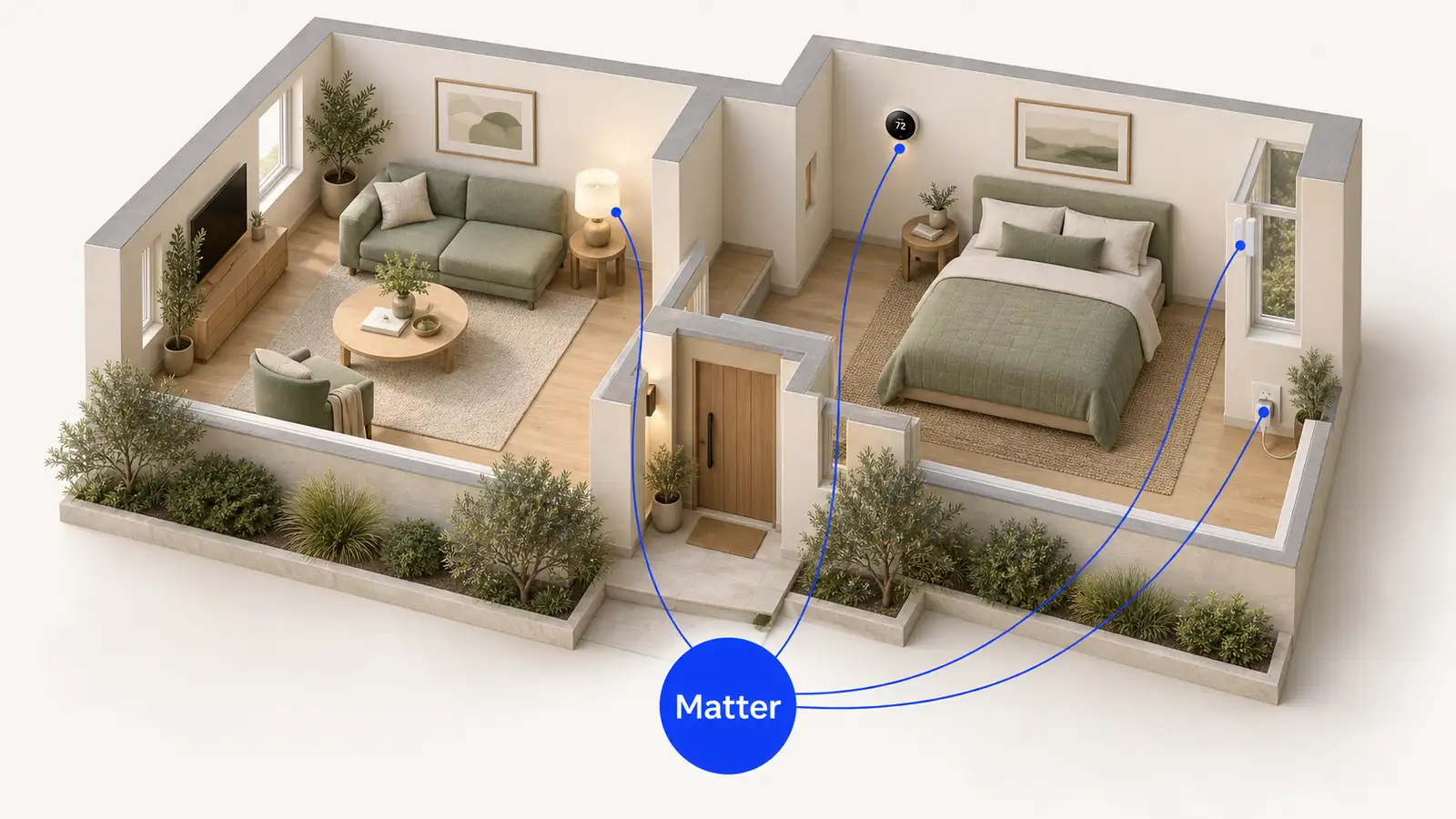
The last question is the dullest and the most useful two years from now. Does it speak an open standard? A device that exposes its event through Matter connects to the major platforms without tying you to one brand. We wrote about it in what Matter is.
Frequently Asked Questions
A contact sensor on a door or window, because it detects a binary event without ambiguity or false positives. Its limit is the moment it fires, which for many departure automations is already too late.
Because they require remembering to press them. They work for deliberate actions and fail for anything that should happen automatically. On rushed days, pressing is the first thing to go.
Yes, technically. In practice it needs an unlocked phone in hand and one extra gesture, so it inherits the button's problem. It works better in contexts where the phone is already the main tool.
A motion sensor detects people who move and misses people who sit still. A millimeter-wave sensor also detects stationary presence. Neither one recognizes who the detected person is.
No. Many triggers work with Alexa, Google Home or Apple Home. Home Assistant matters if you want complex logic, local control and integrations the commercial platforms don't offer.
Keep reading
 Smart homeWhy leaving-home automations fire lateLeaving-home automations fire late because almost all of them rely on your phone's location, which gets sampled at intervals across a radius of at [...]Written by Federico Zarantonello
 Smart homeWhat Matter is and why it changes the smart homeMatter is a standard that lets smart devices from different brands talk to each other without a separate app for each one. A Matter-certified device [...]Written by Federico Zarantonello
 EntrywaySmart key tray: what it is and how it worksA smart key tray is an entryway tray that notices when you pick up or put down your keys and uses that moment to remind you of something. From the [...]
 Written by Thomas David Short